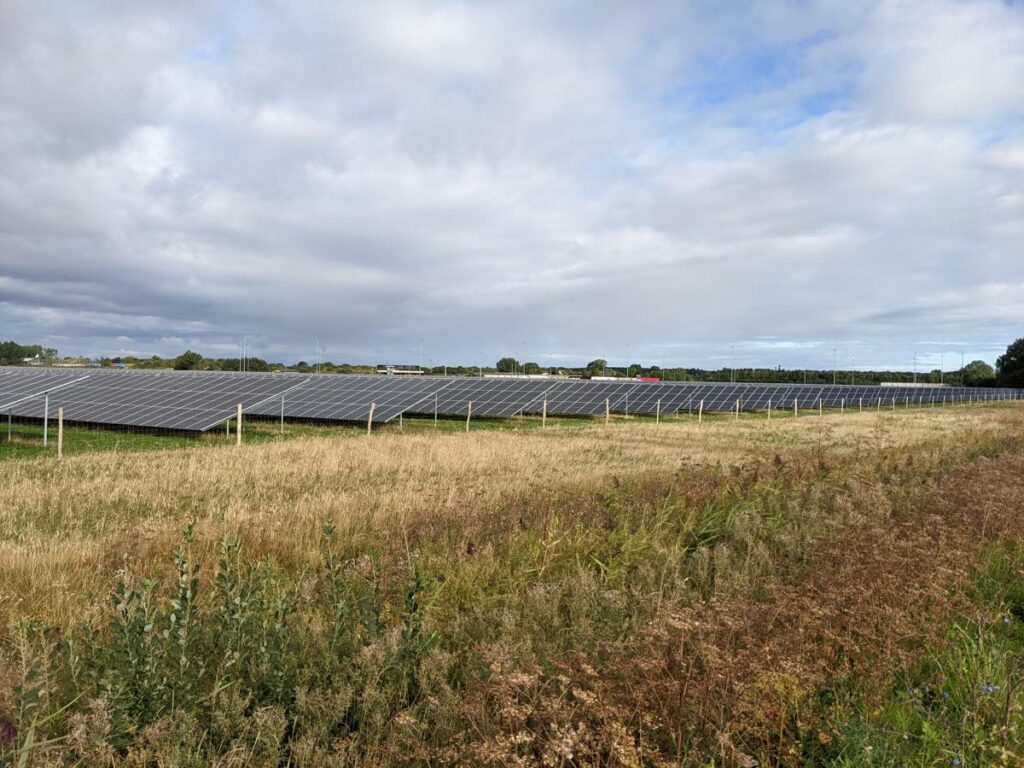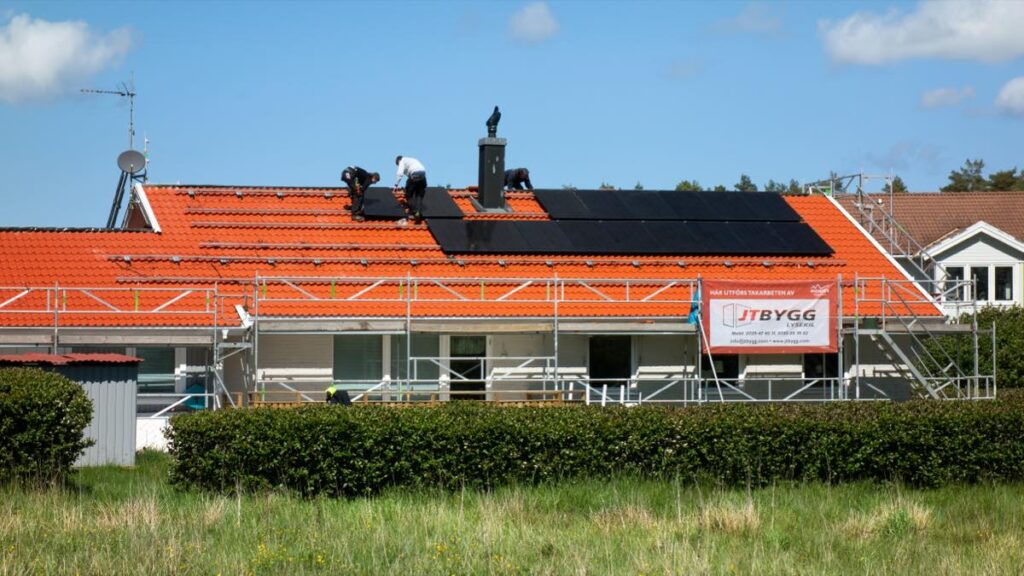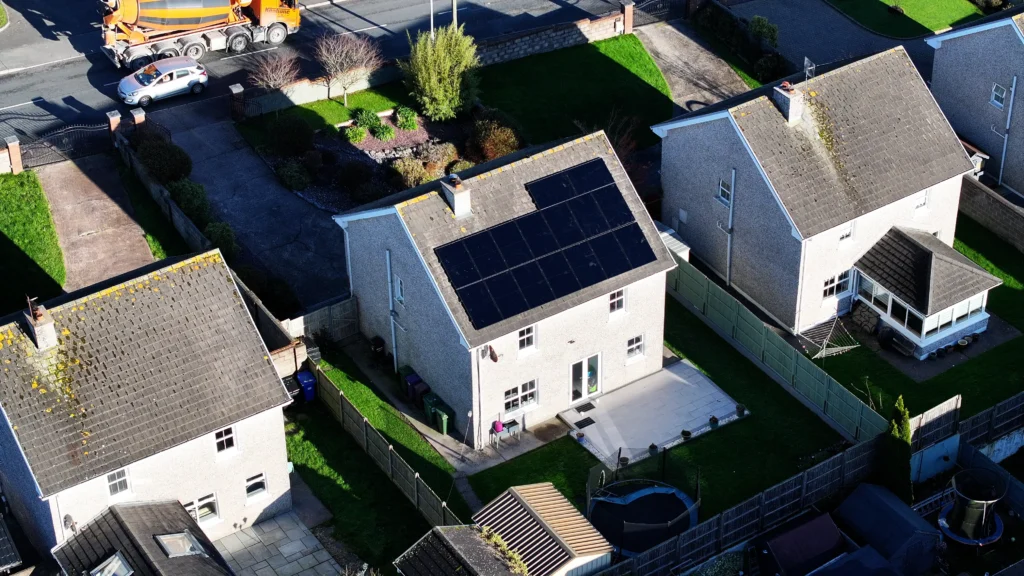
A commercial solar installation in Ireland typically costs between €1,100 and €1,500 per kWp installed, before grant support. For most businesses that means €22,000-€30,000 for a 20 kWp rooftop system, or €100,000-€140,000 for 100 kWp. But the headline price is the least useful number in the quote. What determines whether the investment works is the net cost after grant and tax relief, and the cost per kWh it locks in for the next 25 years.
This is a breakdown of where the money actually goes, which variables move the price most, and which costs are routinely left out of quotes.
What a Commercial Solar System Costs by Size
| System Size | Typical Cost (excl. VAT) | Cost per kWp | Indicative Roof Area |
|---|---|---|---|
| 20 kWp | €22,000-€30,000 | €1,100-€1,500 | ~85 m² |
| 50 kWp | €55,000-€75,000 | €1,100-€1,500 | ~210 m² |
| 100 kWp | €100,000-€140,000 | €1,000-€1,400 | ~420 m² |
Cost per kWp falls as systems get larger. Scaffolding, design, grid paperwork and mobilisation are largely fixed - spreading them across 100 kWp rather than 20 kWp is what drives the unit cost down. This is why undersizing a system to reduce the headline price usually makes the economics worse, not better.
Where the Money Actually Goes
Panels are the thing everyone compares, and they are rarely the deciding factor. A rough split for a typical commercial rooftop installation:
| Component | Share of cost | What moves it |
|---|---|---|
| PV panels | ~30-40% | Tier-1 vs budget, efficiency, warranty terms |
| Inverters | ~10-15% | String vs optimised; replacement cycle |
| Mounting & ballast | ~10-15% | Flat vs pitched, roof structure, wind loading |
| Electrical & cabling | ~10-15% | Distance from array to switchroom |
| Install labour & access | ~15-20% | Roof height, scaffolding, working at height |
| Design, grid & commissioning | ~5-10% | Grid application complexity, protection studies |
The practical implication: two quotes with identical panels can differ by 20% because one accounts properly for roof access and cable runs and the other has not surveyed the site.
The Five Variables That Move the Price Most
- Mounting type. Ground-mounted arrays need groundworks, frames and trenching, and typically run higher per kWp than a simple flat-roof ballasted system - but they remove roof constraints entirely.
- Roof condition and structure. A roof needing structural reinforcement, or one within a few years of replacement, changes the project. Installing on a roof you will strip in five years means paying to remove and refit the array.
- Access and height. Warehouse roofs need scaffolding, mewps or safety systems. This is labour, not equipment, and it does not fall with panel prices.
- Distance to the connection point. A long cable run from a far roof to the switchroom adds copper and labour disproportionately.
- Grid connection requirements. The larger the system, the more grid connection and protection work is involved - and the more lead time.
The Costs Quotes Leave Out
Compare quotes on total lifetime cost, not the installed price. These items are frequently absent:
- Inverter replacement. Panels are warranted for decades; inverters are not. Budget for at least one replacement across a 25-year life.
- Ongoing O&M. Monitoring, inspection, cleaning and fault response. A commercial array left unmonitored can underperform for months before anyone notices - which is precisely the value an O&M contract protects.
- ESB Networks connection process. Your installer must apply to ESB Networks before installation, and that application alone takes at least four weeks.
- Post-installation electrical works. Switchboard upgrades or metering changes uncovered during survey.
- Insurance and structural sign-off where the roof loading needs certification.
Net Cost Is the Number That Matters
Two mechanisms cut the real cost substantially, and they stack.
The SEAI Non-Domestic Microgen Grant pays up to €162,600, scaled by system size - €12,600 on a 50 kWp system, €22,600 on 100 kWp. Unlike the domestic scheme, there is no property-age restriction. Our full guide to the NDMG grant covers the rates and application process.
The Accelerated Capital Allowance then lets you write off 100% of the qualifying equipment cost against taxable profits in year one. For a company paying corporation tax at 12.5%, a €75,000 installation produces a €9,375 tax saving in the first year rather than spread over eight.
| 100 kWp system | Amount |
|---|---|
| Installed cost (indicative) | €120,000 |
| Less NDMG grant | −€22,600 |
| Less year-one ACA benefit @ 12.5% | −€12,175 |
| Effective net cost | ~€85,225 |
Illustrative only - ACA benefit depends on your tax position and assumes sufficient taxable profits. But it shows why comparing headline quotes against each other, rather than net cost against your electricity bill, is the wrong comparison.
The Real Benchmark: Cost per kWh
Irish businesses are paying roughly 25-35 cent per kWh. Amortised over a 25-year panel life, electricity from a commercial solar array typically costs below 5 cent per kWh. Every unit you generate and consume on site displaces a unit at the higher price - that spread, not the grant, is where the return comes from.
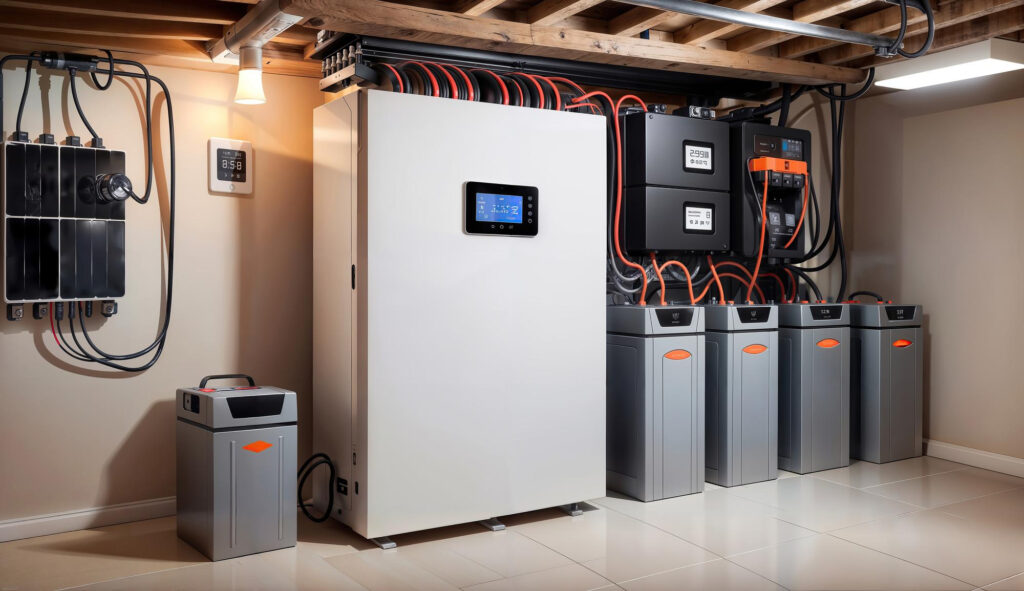
It also explains why self-consumption beats export. Exported surplus earns roughly 19-21 cent under the Clean Export Guarantee - real money, but less than the 25-35 cent you avoid by using it yourself. Sizing should follow your actual half-hourly load profile rather than the available roof area, and a business running plant overnight may get more from pairing solar with battery storage than from adding panels.
How to Compare Quotes Properly
- Ask for cost per kWp, not just the total - it is the only figure that compares across sizes.
- Ask for annual generation in kWh and the assumed self-consumption percentage. A quote assuming 90% self-consumption for a business that shuts at 5pm is not credible.
- Confirm the quote is based on your actual consumption data, not a national average.
- Check whether grid application, scaffolding and commissioning are included or excluded.
- Confirm the installer is on the SEAI Non-Domestic register - without it, the NDMG grant is not available to you.
Key Points
- Commercial solar runs roughly €1,100-€1,500 per kWp installed, falling as system size rises.
- Panels are only 30-40% of the cost - access, mounting and electrical work drive the differences between quotes.
- The NDMG grant and the Accelerated Capital Allowance stack, cutting net cost substantially.
- Solar generation costs under 5 cent per kWh against a 25-35 cent grid price - that spread is the return.
- Budget for inverter replacement and O&M; they are absent from most headline quotes.
For the wider financial picture - grants, tax treatment, export income and payback - see our guide to commercial solar ROI in Ireland. If you want a costed design based on your own consumption data rather than an average, talk to our engineering team or read more about our commercial solar service.
Grant support reduces these figures materially, and the rates by system size are set out in our guide to the SEAI Non-Domestic Microgen Grant. Where export is limited by the grid connection, battery storage is often what recovers the payback. For commercial and agricultural sites in our home county, see solar panels in County Tipperary.
Deciding between installers? See what Mitros customers say, rated 4.6 out of 5 from 70 verified Trustpilot reviews.